Social jet lag: why weekends can shift your sleep
Social jet lag describes the mismatch between biological timing and social schedules, often visible as different sleep timing on workdays and free days. It is not travel jet lag, and a weekend lie-in alone does not diagnose a sleep disorder.
- Sleep timing and sleep duration are related but distinct.
- A large free-day shift can include recovery from short workday sleep.
- An estimate from a diary is not a diagnosis or a risk score.
Key facts for your sleep plan
Wittmann and colleagues (2006) described social jet lag in relation to chronotype and social schedules. Their questionnaire study found associations, which should not be read as proof that a given weekend pattern causes a disease.
A simple descriptive comparison uses the midpoint between sleep onset and waking on each type of day. Free-day recovery sleep can affect the estimate, so do not treat an uncorrected midpoint as your pure biological preference.
A practical starting plan
- Record actual sleep onset and waking for workdays and free days.
- Compare timing as well as total sleep opportunity.
- Identify the fixed early commitment or late evening activity behind the mismatch.
- Negotiate one realistic change without shortening free-day sleep just to make the numbers match.
Worked example and a common myth
Illustrative calculation: sleeping from 23:00 to 7:00 gives a midpoint of 3:00; sleeping from 1:00 to 9:00 gives 5:00. The descriptive difference is two hours. It is not a clinical threshold and does not tell you your individual health risk.
Example: if an early Monday meeting is fixed, move optional Sunday work earlier and prepare its materials before the evening. Where possible, discuss meeting timing rather than blaming yourself for not having a different chronotype.
Separate the clock difference from the sleep shortfall
Social jet lag is about a mismatch in timing. Sleep debt is about missing sleep relative to your need. They can occur together: an early workday alarm may shorten the night, while a free day allows both later timing and more sleep. Treating every late weekend wake-up as the same problem hides those differences.
AASM/SRS guidance emphasises regularly getting enough adult sleep. A smaller midpoint difference achieved by cutting your free-day sleep is therefore a poor goal. First ask whether the workweek gives you enough opportunity to sleep at all, then consider how much the timing shifts.
NHLBI’s explanation of sleep debt helps frame the recovery component. A diary is useful for seeing the pattern, but your raw free-day midpoint is not a pure reading of an internal clock. Catch-up sleep, care duties and social events can all affect it.
Read a simple midpoint table without turning it into a score
| Illustrative pattern | Sleep period | Midpoint |
|---|---|---|
| Workday | 23:00–07:00 | 03:00 |
| Free day, same duration | 01:00–09:00 | 05:00 |
| Free day with longer sleep | 01:00–10:00 | 05:30 |
The first comparison has a two-hour midpoint difference with equal duration. The third row adds duration as well. These are arithmetic examples, not thresholds for illness or categories of good and bad sleepers. A formal chronotype assessment may account for recovery sleep rather than interpreting the raw midpoint alone.
Record approximate actual sleep onset and waking, not just getting into bed. Precision to the minute is unnecessary for an everyday planning decision. Do not stay awake monitoring the clock to produce a better diary; an ordinary estimate with context is more useful.
A week of observations, followed by one negotiation
During the first ten minutes, list the fixed commitments that determine your earliest mornings. Include the commute and household preparation. Beside them, write the late activities that determine when the evening ends. Choose one part of the mismatch that you can change without reducing needed sleep.
Over the week, make a short morning note and add whether it was a workday or free day. Include a late event, extra shift or waking child. At the review, look for repeated constraints instead of treating the most unusual night as your normal pattern.
A night owl working 9–5 might ask to move the most demanding meeting later while keeping routine availability in the morning. A student might prepare travel and materials the evening before an early class. A parent may need a shared weekend morning rather than an earlier alarm.
A useful request names the task and time: “I can cover the morning messages, but can we make the detailed review at ten?” This gives another person something practical to consider. It does not require a claim that you have a diagnosed condition or an unchangeable productivity profile.
Myth: the solution is to abolish the weekend lie-in
Removing recovery while leaving short work nights intact can make the schedule look more consistent and leave you more tired. Work on the cause of the restriction as well as the timing. A gentler Sunday evening and fewer optional early commitments may be more useful than a strict alarm alone.
CDC/NIOSH guidance supports daytime light as part of a workable routine. For a daytime schedule, look for an outdoor opportunity after waking or later in the morning; this is a practical support, not an exact dose that guarantees a particular shift. Night workers need advice matched to their main sleep.
On a bad day, reduce the workload and keep the next step small. Avoid turning a difficult Monday into a late Monday catch-up session that repeats the pattern. Use the printable to note one fixed constraint, one adjustable commitment and the result of your next attempt. Associations in social-jetlag research are not personal risk predictions.
Printable planning sheet
Social jet lag: why weekends can shift your sleep
Date: __________ What I want to try: ____________________
- ☐ Record actual sleep onset and waking for workdays and free days.
- ☐ Compare timing as well as total sleep opportunity.
- ☐ Identify the fixed early commitment or late evening activity behind the mismatch.
- ☐ Negotiate one realistic change without shortening free-day sleep just to make the numbers match.
How CORTEX can help
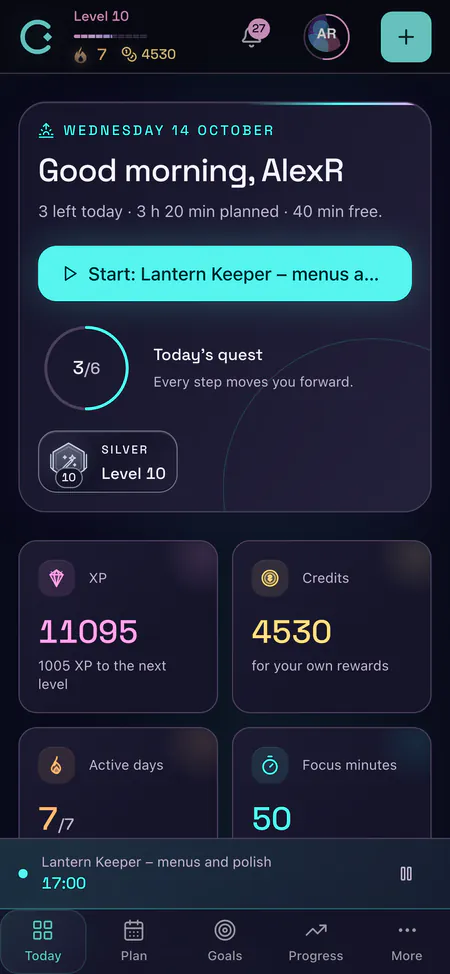
Make the boundary visible. In Habits, create a wind-down action tied to your own schedule, such as “Close work at 22:00”. Track something you can do, rather than whether you fell asleep on command. Choose a realistic weekly target; daily habits include an automatic free rest day each week, so an imperfect evening need not end your streak.
Keep a useful record. In Journal, note approximate sleep times, the last caffeinated drink and one observation about daytime energy. Add context such as a noisy night or an unexpected shift. The evening review gives you somewhere to acknowledge what moved forward and put the day down, even when the task list is unfinished.
Protect the hours that work. In Plan, move one demanding task into a period when you are normally alert. Use Focus for that task and stop for a break when the block ends. Compare how the work felt with your usual timing before moving the rest of the week; a small change is easier to assess than a completely rebuilt routine.
Give yourself an off-ramp. Calm offers guided breathing for the transition out of work. The Academy lesson “Energy through the day” helps you try a different work window. CORTEX supports your planning and observations; it does not measure sleep stages or calculate your biological sleep requirement.
When to seek help
Ask yourself: do difficulties persist even when there is enough opportunity to sleep? Does sleepiness interfere with ordinary activities? These questions can help prepare a conversation with a professional; they are not a diagnostic test.
This guide offers general support, not medical advice. If insomnia lasts for weeks, fatigue persists or loud snoring includes breathing pauses, speak with a healthcare professional. Do not drive when sleepy.
Related guides
Continue with: Sleep debt: can weekend catch-up really help? · Shift work and sleep: protect rest around nights · Chronotype and productivity: find your work window · Sleep and learning: study without an all-nighter · Low-energy day plan: protect rest and essentials
Frequently asked questions
Is social jet lag the same as being a night owl?
No. Chronotype concerns preferred timing; social jet lag concerns a mismatch with social schedules.
How do I estimate it?
Compare workday and free-day sleep midpoints, while remembering that catch-up sleep affects the estimate.
Should I shorten weekend sleep to match?
Do not reduce needed sleep solely to improve a timing metric. Address the weekday restriction and schedule mismatch.
Does a two-hour difference mean I am ill?
No. The example is arithmetic, not a diagnostic threshold. Persistent symptoms deserve appropriate assessment.
Sources and further reading
Record one observation
In Journal, record sleep onset and waking for one workday and one free day.
Open Journal