Shift work and sleep: protect rest around nights
A shift-work sleep plan starts by protecting a main sleep opportunity around the actual roster, commute and home responsibilities. Night work can conflict with the body clock; planning can reduce avoidable disruption but cannot remove the health and safety risks.
- A roster is a starting constraint, not a reason to skip recovery.
- A plan for daytime workers cannot simply be copied after a night shift.
- Sleepiness during the commute needs a safety decision, not another productivity trick.
Key facts for your sleep plan
NHLBI suggests limiting caffeine to the first part of a shift, reducing light and noise in the bedroom for daytime sleep, and discussing persistent adaptation problems with a doctor. This is general guidance, not an individual light-therapy or medication protocol.
| Constraint | Planning response |
|---|---|
| Early handover | Prepare essential notes before fatigue builds. |
| Daytime sleep | Agree a quiet period with the household and reduce room light. |
| Changing roster | Rebuild the plan from the actual shift times. |
| Sleepy journey home | Arrange safe transport; do not drive while sleepy. |
A practical starting plan
- Write down the shift, handover and commute as fixed commitments.
- Protect the main sleep opportunity before adding errands or study.
- Put optional admin outside the recovery period and keep caffeine earlier in the shift.
- Review with your employer or clinician if the schedule repeatedly leaves you unable to sleep or travel safely.
Worked example and a common myth
Example: after a night shift, a household delivery and a study session compete with daytime sleep. Move the delivery or ask someone else to handle it; postpone the optional study block. A full calendar is not evidence that recovery is optional.
Myth: being a night owl makes all night work harmless. Preference for later hours does not remove the need for sleep or make fatigue-related risk disappear.
Plan the whole shift cycle, including getting home
For a night worker, bedtime belongs after work even when the rest of the household is beginning its day. A useful sleep plan starts with the actual rota, commute and care duties. Add them before choosing a sleep window; otherwise the attractive block on the calendar may never be available in real life.
NIOSH guidance on the sleep environment supports a dark, quiet and comfortably cool space. That can mean blackout curtains, reducing household noise and agreeing which calls are urgent. Keep a safe clear route through the room; blocking light should not create a trip hazard.
The AASM/SRS recommendation for sufficient adult sleep remains relevant when sleep occurs during the day. The aim is enough protected opportunity, not proving that you can function on less. Short gaps between duties and repeated schedule changes are workplace issues as well as personal planning problems.
A worked example for a night shift
Suppose your shift runs from 22:00 to 06:00 and the journey home takes half an hour. The following is a planning example, not a prescription for every rota. It shows the decisions that need explicit space.
| Part of the cycle | Example decision |
|---|---|
| Before work | Prepare food, transport and the sleeping room before leaving. |
| During work | Use approved breaks and plan caffeine relative to the coming sleep. |
| After 06:00 | Assess whether getting home is safe; avoid adding optional errands. |
| At home | Keep the wind-down simple and protect a long enough sleep opportunity. |
| After waking | Allow ordinary preparation before the next duty. |
If childcare or another job cuts through the intended sleep window, name that conflict directly. A split arrangement may need coordination and professional advice; it is not solved by labelling every remaining hour “free time”. The plan must reflect what is genuinely available.
After a late evening shift, the missing buffer before bed is another common problem. {a('shift','NIOSH’s evening-shift guidance')} addresses winding down, bright light and the sleeping room. An evening shift and a full overnight shift should not receive identical clock-based instructions.
The first ten minutes of making a rota-based plan
Take the next sequence of shifts and mark the start, finish and commute. Then block the intended main sleep, allowing your usual preparation and time to fall asleep. Check the block against school runs, deliveries, calls and household routines. Ask for help with the first real collision instead of assuming you will somehow sleep around it.
Choose one person who needs to know your availability. A clear message is: “I need this period protected after the night shift. Please leave routine calls until I am up; use this route for an emergency.” Agreements can cover noise, meals and who handles the door as well as phone calls.
With a manager, make the request concrete: “These two duties leave too little opportunity for sleep after travel. Can we review the gap or swap this duty?” Bring the actual rota rather than a general promise to cope better. The employer’s fatigue procedures and occupational health service can be part of the solution.
Caffeine, naps and the first day off
Drake and colleagues (2013) found sleep disruption after a 400 mg caffeine dose even six hours before bed. The dose and timing matter; midnight is not a universal cutoff for someone whose main sleep starts in the morning. Consider the next sleep period rather than copying a daytime worker’s rule.
A short nap may be useful where workplace rules allow it, but leave room to become alert afterwards. The general nap evidence does not establish a complete strategy for every rotating rota. Likewise, do not apply “seek morning light” mechanically when you are about to sleep after a night shift.
On the first day off, avoid scheduling every postponed errand immediately after work. Decide what truly needs doing and arrange help where possible. If the plan repeatedly leaves too little sleep, change the demands rather than adding more complicated rituals. The printable helps you record the rota, protected sleep and one practical request.
Printable planning sheet
Shift work and sleep: protect rest around nights
Date: __________ What I want to try: ____________________
- ☐ Write down the shift, handover and commute as fixed commitments.
- ☐ Protect the main sleep opportunity before adding errands or study.
- ☐ Put optional admin outside the recovery period and keep caffeine earlier in the shift.
- ☐ Review with your employer or clinician if the schedule repeatedly leaves you unable to sleep or travel safely.
How CORTEX can help
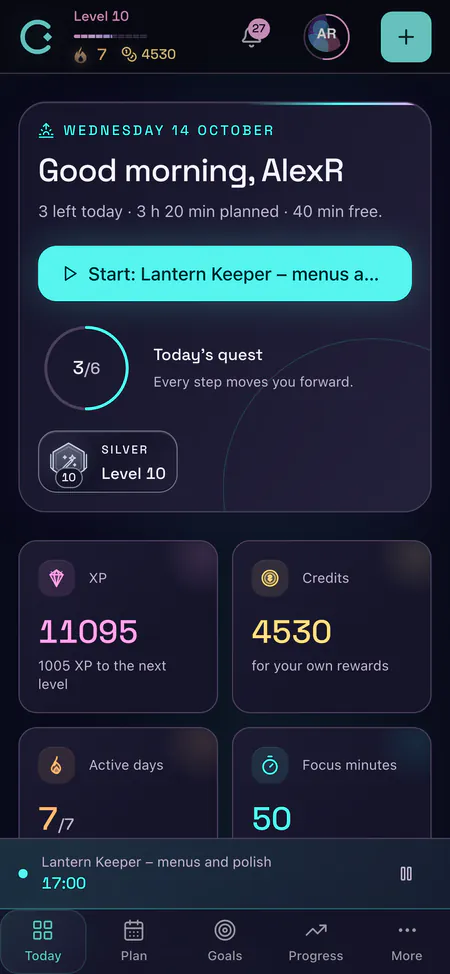
Make the boundary visible. In Habits, create a wind-down action tied to your own schedule, such as “Prepare the bedroom after my shift”. Track something you can do, rather than whether you fell asleep on command. Choose a realistic weekly target; daily habits include an automatic free rest day each week, so an imperfect evening need not end your streak.
Keep a useful record. In Journal, note approximate sleep times, the last caffeinated drink and one observation about daytime energy. Add context such as a noisy night or an unexpected shift. The evening review gives you somewhere to acknowledge what moved forward and put the day down, even when the task list is unfinished.
Protect the hours that work. In Plan, move one demanding task into a period when you are normally alert. Use Focus for that task and stop for a break when the block ends. Compare how the work felt with your usual timing before moving the rest of the week; a small change is easier to assess than a completely rebuilt routine.
Give yourself an off-ramp. Calm offers guided breathing for the transition out of work. The Academy lesson “Energy through the day” helps you try a different work window. CORTEX supports your planning and observations; it does not measure sleep stages or calculate your biological sleep requirement.
When to seek help
Ask yourself: do difficulties persist even when there is enough opportunity to sleep? Does sleepiness interfere with ordinary activities? These questions can help prepare a conversation with a professional; they are not a diagnostic test.
This guide offers general support, not medical advice. If insomnia lasts for weeks, fatigue persists or loud snoring includes breathing pauses, speak with a healthcare professional. Do not drive when sleepy.
Related guides
Continue with: Sleep debt: can weekend catch-up really help? · Social jet lag: why weekends can shift your sleep · Chronotype and productivity: find your work window · Sleep and learning: study without an all-nighter · Low-energy day plan: protect rest and essentials
Frequently asked questions
How should I sleep after a night shift?
Protect a main sleep opportunity and reduce bedroom noise and light. Tailor the timing to the actual roster and seek help if it repeatedly fails.
When should I stop caffeine on nights?
NHLBI suggests keeping it to the first part of the shift; relate the cutoff to planned sleep rather than noon.
Can a nap make the drive home safe?
A nap does not guarantee immediate alertness. Do not drive when sleepy; arrange a safe alternative.
Can CORTEX assess shift-work health risks?
No. It helps organise commitments and recovery time, not diagnose a sleep disorder or certify safe working hours.
Sources and further reading
Leave room for recovery
In Plan, enter the next shift and protect the main sleep opportunity before adding optional errands.
Open Plan