Sleep debt: can weekend catch-up really help?
Sleep debt is accumulated sleep loss relative to your needs. Extra sleep can ease sleepiness, but a weekend lie-in is not a guaranteed reset for repeated short nights; the practical priority is protecting sleep during the week.
- Sleep debt is a useful concept, not a precise recovery invoice.
- Feeling better is not proof that every effect has reversed.
- Recovery research depends on the schedule and outcome being studied.
Key facts for your sleep plan
NHLBI describes sleep debt as accumulated sleep loss. NICHD distinguishes reduced drowsiness from reversing the effects of insufficient sleep.
In a controlled study of healthy young adults, Depner and colleagues (2019) found that weekend recovery did not prevent measured metabolic disruption when restricted sleep resumed. That does not establish that extra sleep is useless, or predict every outcome for every person.
A practical starting plan
- Identify the recurring evening commitment that cuts sleep short.
- Move or remove one optional commitment before the next workday.
- Keep recovery time without using it as permission for another short night.
- Reduce safety-critical activity when sleepy; do not rely on caffeine to certify alertness.
Worked example and a common myth
Illustrative arithmetic: missing an hour on each of five nights adds up to five hours. It does not follow that exactly five extra hours at the weekend restores every function. A diary can expose the pattern but cannot calculate full physiological recovery.
Example for a freelancer: stop polishing a low-priority deliverable late at night and renegotiate its scope. The useful change is reducing repeated restriction, rather than chasing a perfect sleep score.
A useful metaphor, rather than a repayment schedule
Sleep debt describes the sleep you have missed relative to what you need. The arithmetic can reveal a pattern of short work nights, but it cannot tell you the exact recovery time for every aspect of attention, mood or metabolism. Feeling better after a long sleep is useful information; it is not a receipt showing that every consequence has been reversed.
The AASM/SRS consensus (Watson and colleagues, 2015) recommends that adults regularly get at least seven hours. The word regularly matters. A weekly average can hide very different nights, so it is worth looking at the workweek itself instead of making Sunday responsible for all your recovery.
The Depner study linked below tested a specific pattern of sleep restriction and weekend recovery in controlled conditions. Its metabolic findings challenge the idea of a complete weekend reset, but they do not give an individual disease prediction or establish that extra sleep is useless.
What the weekend can reasonably do
| Question | Practical interpretation |
|---|---|
| Can sleeping longer help me feel less sleepy? | It can; feeling better and complete recovery are different outcomes. |
| Should I set an early alarm to avoid catching up? | Do not shorten needed sleep solely to improve a timing statistic. |
| What is the first thing to change? | The repeated reason your work nights are too short. |
A late weekend wake-up can contain both extra sleep and a shift in timing. Keep those questions separate. If you fall asleep later and wake later, look at social jet lag as well. If you simply have a longer opportunity to sleep, examine what removes that opportunity during the week.
Leave enough room for ordinary weekend life without turning it into another endurance test. A packed Saturday, an early Sunday alarm and late Sunday work may preserve the same restriction you were trying to escape. You can choose a smaller list of commitments without making recovery your entire identity.
A seven-day plan to reduce the recurring shortfall
Day one: spend ten minutes mapping the last few work nights. Name the repeated obstacle: late study, unfinished admin, caregiving or a shift pattern. Choose one optional activity to move and give it a real alternative slot. “Do less at night” becomes actionable when you know what will happen instead.
The next workdays: protect the space you freed and make a brief morning note. If the evening still runs late, record why. An unexpected care need requires a different response from automatically opening another episode. Keep the plan focused enough that you can adjust it without rebuilding the whole week.
Free days: allow recovery and notice whether the whole sleep period moves later. Avoid deliberately restricting sleep just to match a number. Before the next early workday, prepare clothes, transport and materials so the morning does not need extra time.
Review: ask whether the change was possible and repeatable. If not, the next step may be fewer commitments or a conversation about workload. Seven days is the length of this planning experiment, not a promised biological recovery period.
Students, parents and deadline-heavy work
A student can replace an all-night attempt to cover everything with a smaller set of high-priority topics and a clear stopping point. A parent with repeated night waking may need shared care and practical help rather than stricter bedtime rules. A freelancer may need to negotiate which delivery can move, rather than perform another unpaid night shift at home.
Dutheil and colleagues’ nap review supports short-term cognitive benefits, particularly alertness; it does not show that a nap replaces adequate nightly sleep. NHLBI guidance also addresses regular timing and a suitable sleep environment. Use these as supports for a workable routine, rather than permission to keep the overload unchanged.
On a difficult day, choose the essential task and reduce activities where sleepiness creates risk. Do not turn unfinished work into another short night by default. The printable below helps you identify the recurring cause and the next schedule change, so the next weekend carries less of the burden.
Printable planning sheet
Sleep debt: can weekend catch-up really help?
Date: __________ What I want to try: ____________________
- ☐ Identify the recurring evening commitment that cuts sleep short.
- ☐ Move or remove one optional commitment before the next workday.
- ☐ Keep recovery time without using it as permission for another short night.
- ☐ Reduce safety-critical activity when sleepy; do not rely on caffeine to certify alertness.
How CORTEX can help
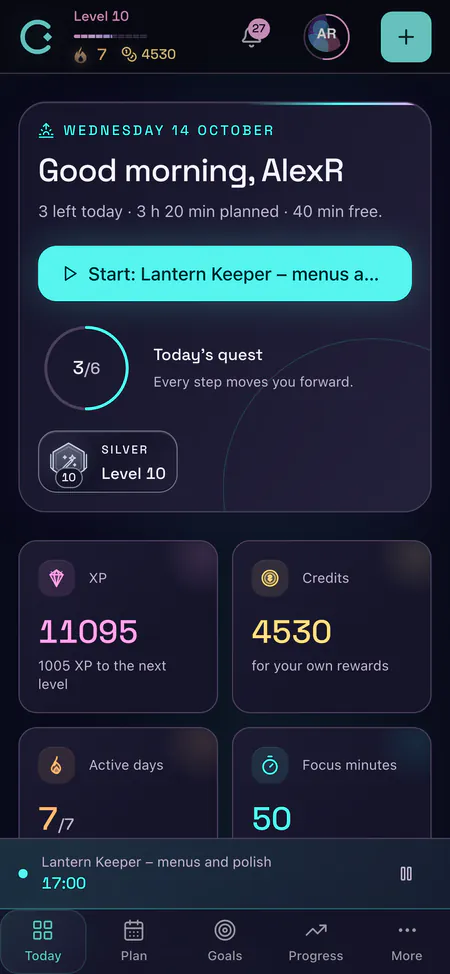
Make the boundary visible. In Habits, create a wind-down action tied to your own schedule, such as “Close work at 22:00”. Track something you can do, rather than whether you fell asleep on command. Choose a realistic weekly target; daily habits include an automatic free rest day each week, so an imperfect evening need not end your streak.
Keep a useful record. In Journal, note approximate sleep times, the last caffeinated drink and one observation about daytime energy. Add context such as a noisy night or an unexpected shift. The evening review gives you somewhere to acknowledge what moved forward and put the day down, even when the task list is unfinished.
Protect the hours that work. In Plan, move one demanding task into a period when you are normally alert. Use Focus for that task and stop for a break when the block ends. Compare how the work felt with your usual timing before moving the rest of the week; a small change is easier to assess than a completely rebuilt routine.
Give yourself an off-ramp. Calm offers guided breathing for the transition out of work. The Academy lesson “Energy through the day” helps you try a different work window. CORTEX supports your planning and observations; it does not measure sleep stages or calculate your biological sleep requirement.
When to seek help
Ask yourself: do difficulties persist even when there is enough opportunity to sleep? Does sleepiness interfere with ordinary activities? These questions can help prepare a conversation with a professional; they are not a diagnostic test.
This guide offers general support, not medical advice. If insomnia lasts for weeks, fatigue persists or loud snoring includes breathing pauses, speak with a healthcare professional. Do not drive when sleepy.
Related guides
Continue with: Shift work and sleep: protect rest around nights · Social jet lag: why weekends can shift your sleep · Chronotype and productivity: find your work window · Sleep and learning: study without an all-nighter · Low-energy day plan: protect rest and essentials
Frequently asked questions
Can I repay sleep debt hour for hour?
There is no reliable personal repayment formula. Extra sleep may help, but recovery differs across outcomes and circumstances.
Is sleeping in always bad?
No. The concern is relying on it to cancel repeated restriction or shifting the schedule so far that the next night becomes short.
Does feeling less tired mean I have recovered?
It indicates relief, not a measurement of all effects of sleep loss.
Should I just force an earlier bedtime?
Create enough time for sleep, but do not turn bedtime into a performance test. Persistent difficulty needs appropriate care.
Sources and further reading
- Watson et al. (2015): AASM/SRS adult sleep consensus
- Dutheil et al. (2021): Short daytime naps and cognitive performance — systematic review and meta-analysis
- NHLBI (2022): Healthy Sleep Habits
- NHLBI (2022): How Much Sleep Is Enough?
- NICHD: What are some myths about sleep?
- Depner et al. (2019): Weekend recovery sleep and recurrent insufficient sleep, Current Biology
- NHS (2024): Insomnia
Leave room for recovery
In Plan, protect one period for rest and choose which optional task can wait.
Open Plan