How to plan your week in 30 minutes (and still have a plan by Wednesday)
To plan your week, set aside 30 minutes at the end of the previous one: empty your head onto one list, check how many hours you really have once meetings and commitments are in, choose three priorities, give each a slot in the calendar, keep a fifth of the time free as a buffer and decide when you will check the plan again. A weekly plan fails less often because people lack discipline and more often because it was built for an ideal week that never comes. The steps below are designed for the week you actually have.
- Plan once a week, at a fixed time: Friday afternoon or Sunday evening, about 30 minutes.
- Start from capacity, not from the to-do list: hours you really have minus meetings, travel and admin.
- Three priorities per week, each with a concrete first step and a slot in the calendar.
- Leave around 20 % of the week unplanned. People reliably underestimate how long tasks take (the planning fallacy).
- A short midweek check (Wednesday) saves more weeks than a perfect Sunday plan.
Why most weekly plans fall apart by Wednesday
A typical weekly plan is a wish list: everything you would like to get done, spread evenly over five days, with no room for the call that runs long or the task that turns out twice as big. By Tuesday afternoon reality has eaten into it, by Wednesday the plan feels wrong, and by Thursday nobody looks at it anymore.
Two well-studied effects explain this. First, the planning fallacy: Roger Buehler, Dale Griffin and Michael Ross (1994) showed that people predict their own tasks will take less time than they do, even when they know similar tasks ran late before. Second, a plan only helps if it says when and where something will happen. In a meta-analysis of 94 studies, Peter Gollwitzer and Paschal Sheeran (2006) found that such concrete “if–then” plans clearly raise the chance of following through.
So a good weekly plan is smaller than you would like, it is anchored in the calendar, and it expects surprises.
How to plan your week in seven steps
- Pick a fixed time (2 minutes). Friday afternoon works for many people because the week is still fresh in your head. Sunday evening works if you like to start Monday with a clear view. What matters is that it repeats.
- Empty your head (5 minutes). Write every open loop on one list: tasks, errands, messages to answer, things you promised. Don’t sort yet. Writing open tasks down together with a plan for them is what quiets the nagging thoughts about them (Masicampo & Baumeister, 2011). If this step alone feels big, a brain dump is the right warm-up.
- Look at last week (5 minutes). What got done, what slipped and why? Move unfinished tasks consciously: do next week, give a date later, or delete. A short weekly review makes this a habit.
- Count your real capacity (3 minutes). Open the calendar for next week. Subtract meetings, classes, travel, family commitments and recurring admin. What is left is the time you can plan. For many people it is half of what they assumed.
- Choose three priorities (5 minutes). Three outcomes that would make the week a good one, even if nothing else happens. Write each as a result (“Proposal sent to the client”), not an activity (“Work on proposal”). The Eisenhower matrix helps when everything looks urgent.
- Block time for each priority (5 minutes). Give each priority one or two blocks in the calendar, preferably when your energy is highest. A task with a time slot is a plan; a task without one is a hope. Time blocking explains how big the blocks should be.
- Keep a buffer and set a check-in (5 minutes). Leave about a fifth of your free time unplanned – that is where the overruns go. Then put a 10-minute check on Wednesday in the calendar.
A weekly plan template you can copy
Copy this into a notebook or print it. It is deliberately short – a plan you can read in thirty seconds is a plan you will keep reading.
My week
Week of: ____________ · Friday: what went well, what do I change next week?
| Part | What I write |
|---|---|
| Hours I really have (after fixed commitments) | |
| Priority 1 – result and first step | |
| Priority 2 – result and first step | |
| Priority 3 – result and first step | |
| Fixed appointments and deadlines | |
| Buffer (when is my free time?) | |
| Wednesday check: on track / adjust |
If you prefer a full page with days and time slots, use the printable weekly planner. If you would like the plan built for you from your priorities and fixed appointments, try the free weekly plan generator.
How much should you plan in a week?
Less than you think. A practical rule: plan your three priorities plus the routine work you already know, and leave the rest of the week open. If your calendar shows 30 free hours, plan around 24 of them and keep the remaining 6 for whatever comes up.
- Estimate, then add. Write down how long a task will take, then add half again for anything you have not done before. The planning fallacy is not a character flaw; it happens to almost everyone.
- Batch the small stuff. Emails, invoices, calls and errands go into one or two blocks a week instead of interrupting deep work every day (see task batching).
- Protect one long block. Two hours of uninterrupted focus on your most important priority usually moves it further than ten scattered half-hours.
The midweek check: 10 minutes that rescue the week
On Wednesday, look at three things: are the three priorities moving, what new has arrived, and what needs to go? The usual answer is to push one or two lower-priority tasks to next week or drop them, not to work late to keep the original plan. Adjusting the plan is part of planning, not a failure.
On Friday, close the week with two questions: what went well, and what will you do differently next week? Over a few weeks these answers teach you how big your weeks really are.
Plan your week in CORTEX
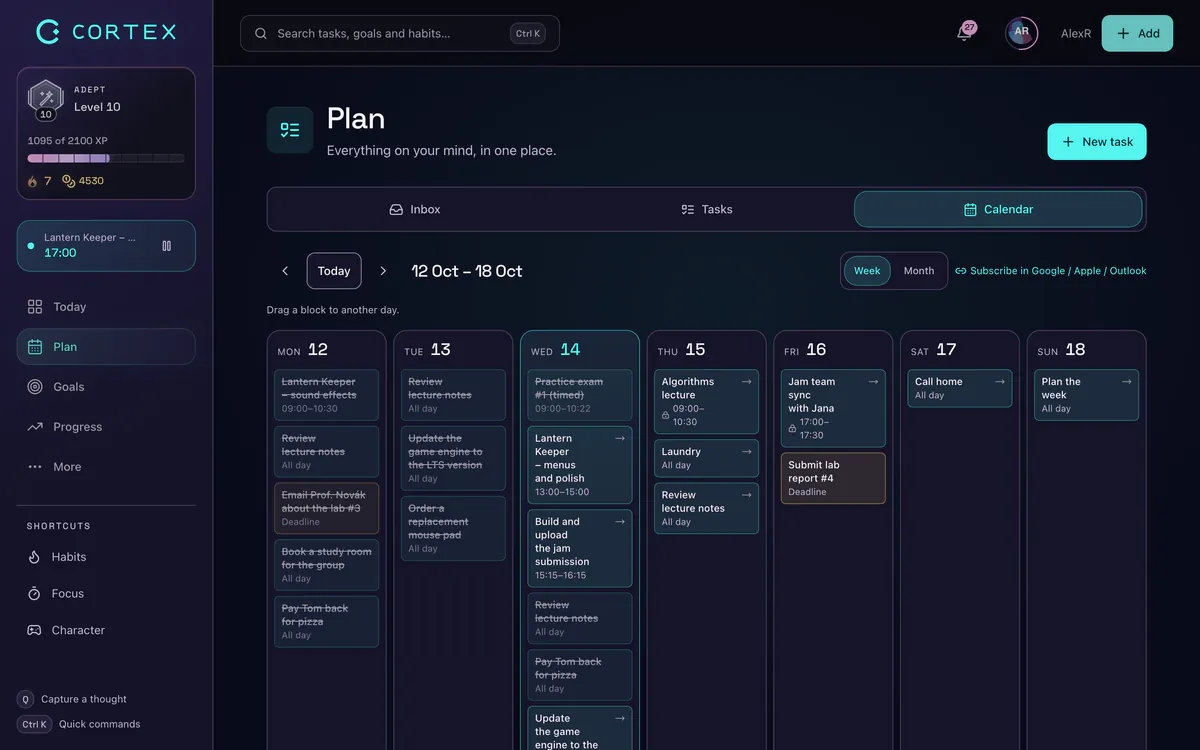
In CORTEX (free for everyone) you type tasks the way you think them – “Friday 10am proposal for Anna ~90m !!” sets the day, time, length and priority. The calendar shows the week as an hour grid, so you see your real capacity before you plan, and you can drag tasks into blocks. Each morning, Plan My Day fits the rest of the day’s tasks around fixed appointments and keeps a buffer. The Weekly review template (More → Templates) adds a recurring half-hour slot for planning with a short checklist. If you have an account, open the planner or the Weekly review template.
Frequently asked questions
When is the best time to plan your week?
At a fixed time at the end of the previous week. Friday afternoon works well because the details are still fresh; Sunday evening suits people who want a clear start on Monday. Consistency matters more than the exact day.
How long should weekly planning take?
About 30 minutes once it is routine: five minutes to empty your head, five to look back, a few to check capacity, and the rest to choose and schedule three priorities. The first few times may take closer to an hour.
How many tasks should I plan for a week?
Plan three priorities plus the routine work you already know, and leave around 20 % of your free time unplanned. If everything is a priority, the plan will not survive the first surprise.
What is the difference between a weekly plan and a to-do list?
A to-do list says what needs doing; a weekly plan says what you will do this week and when. The plan is smaller than the list and is anchored in the calendar.
What if my week never goes to plan?
Plan less, keep a bigger buffer and add a 10-minute check on Wednesday. A plan that adapts midweek is working as intended. If your weeks are consistently overloaded, the issue is usually capacity, not planning.
Sources and further reading
- Buehler, R., Griffin, D. & Ross, M. (1994): Exploring the “planning fallacy”: Why people underestimate their task completion times – Journal of Personality and Social Psychology
- Gollwitzer, P. M. & Sheeran, P. (2006): Implementation intentions and goal achievement: A meta-analysis of effects and processes – Advances in Experimental Social Psychology
- Masicampo, E. J. & Baumeister, R. F. (2011): Consider it done! Plan making can eliminate the cognitive effects of unfulfilled goals – Journal of Personality and Social Psychology
Plan your day in two minutes
Type tasks as plain sentences and CORTEX fits them into a realistic, time-blocked day.
Plan my day for free