Body doubling: why it’s easier to work when someone else is there
Body doubling means working on your own task in the presence of another person – side by side at a table or on a video call – who is doing their own work. They don’t help you or check on you; they’re just there. For many people, especially with ADHD, this makes it much easier to start and stick with tasks they would otherwise put off. Direct studies of body doubling are still scarce. It builds, though, on the long-studied phenomenon of social facilitation and on proven ingredients: a fixed start, an intention said out loud and a light sense of accountability to someone else.
- Body doubling = working on your thing next to someone working on theirs. In person or online, camera on or off.
- The presence of others speeds up simple, well-practised tasks and can slightly impair complex new ones (Bond & Titus, 1983).
- How much it helps depends on personality: people energised by social situations benefit more (Uziel, 2007).
- Direct research on body doubling, including in ADHD, is still mostly anecdotal. Treat it as a tool to try, not a treatment.
- It works best with a fixed start time, an intention said out loud and a short check-out at the end.
What body doubling is
The term spread through ADHD communities and the coaches who work with them. The idea is simple: some tasks – tidying, paperwork, email, studying – you can’t even get started on alone. But when someone sits next to you working on their own thing, suddenly it’s possible.
The “double” doesn’t need to understand your work, give advice or judge you. Being there is enough. It can be a friend, a flatmate, a colleague – or strangers in a shared online sprint where everyone says at the start what they’ll do and then works for an hour.
Why it works: what we know and what we don’t yet
- Social facilitation. Robert Zajonc (1965) described how the presence of others raises arousal. A meta-analysis of 241 studies (Bond & Titus, 1983) showed that with others present, people do simple tasks a bit faster but complex, new tasks a bit worse. The effects are small but consistent.
- It depends on you. Liad Uziel (2007) found that people who are energised and confident in social situations benefit more from others being present; for more anxious people it can be a drag.
- A fixed start and an intention. An agreed time works like a concrete “when and where” plan, and an intention said out loud like a light commitment. Both are well known from goal research (implementation intentions).
- What we don’t know yet. There are still very few good studies on body doubling itself, especially in people with ADHD. Most of what we know comes from people for whom it works. So treat body doubling as a tool worth trying, not as a proven treatment.
How to run a co-working focus sprint
- Agree on a time and length. For example 9:00–10:00, or two 25-minute blocks. A fixed start is half the effect.
- Say what you’ll do at the start. In one specific sentence: “I’ll answer five emails and send one invoice.” Not “I’ll work.”
- Each works on their own thing. No chatting. Online you can have your camera on or off, microphone muted.
- Phone away, one task. Body doubling doesn’t work if you scroll alongside. Close anything you don’t need for the task.
- A short check-out at the end. One minute: what you got done and what’s next. A small sense of progress in front of someone else is a reward that pulls you to the next sprint.
Who body doubling suits – and who less
- Good fit: when you know what to do but can’t get going; for boring, repetitive tasks; when you work alone from home and miss structure in your day; with ADHD, as one way to build external structure (more in how to focus and stop procrastinating with ADHD).
- Less of a fit: brand-new, demanding tasks that need deep thinking – there, others being present can distract. And if being watched, even only in your head, stresses you, try a sprint with your camera off or with one person you know well.
If body doubling helps your attention and you suspect ADHD, it’s worth talking to a professional. This article is general information, not medical advice.
Partner, sprint or co-working space?
- A partner. One person you meet with regularly. Strong accountability, less flexibility (accountability partner).
- An online sprint with several people. Join when it suits you, nobody knows you and the pressure is gentle. Ideal to start with.
- A co-working space or library. Others around you without any arrangement. Works for people who mainly need a change of scene.
Try it now in CORTEX
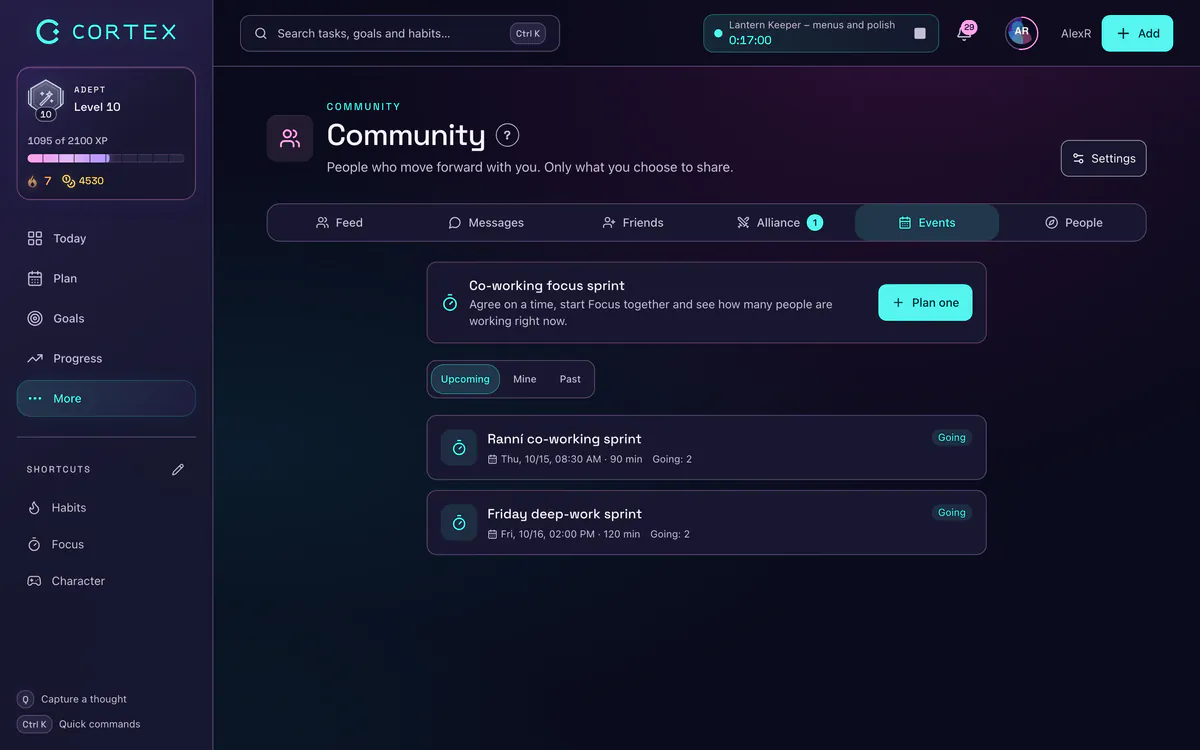
In CORTEX (free for everyone) you’ll find co-working focus sprints under Events in Community: agree on a time, start Focus together and see how many people are working right now. You can also plan a sprint yourself – a time and a length is all it takes – and others join. At the end you see how many minutes of focused work you put in together. The Brain Academy has a short lesson on this, “Better together”. If you have an account, open sprints in Community.
Frequently asked questions
What is body doubling?
Body doubling is working on your own task while another person works on theirs – side by side or online. The other person doesn’t help or check on you; they’re just there. For many people it makes starting and keeping going easier.
Does body doubling work online?
Yes, many people do it on a video call or in shared online sprints, camera on or off. What matters is a fixed start, an intention said out loud and a short check-out at the end.
Does body doubling help with ADHD?
Many people with ADHD say it does, and it makes sense as external structure. But there are still few good studies on body doubling in ADHD specifically, so treat it as a tool to try, not a treatment. Diagnosis and treatment belong with a professional.
Why do I work better when someone is around?
Others being present raises arousal and gently reminds you what you’re meant to be doing. An agreed start and having said out loud what you’ll do help too. Social facilitation research shows this applies mainly to simpler tasks.
How long should a body doubling sprint be?
Usually 25 to 90 minutes. To start, one block of 25–50 minutes is enough. Longer sprints work once you know it suits you and you have a concrete task ready.
Sources and further reading
- Zajonc, R. B. (1965): Social facilitation – Science
- Bond, C. F. & Titus, L. J. (1983): Social facilitation: A meta-analysis of 241 studies – Psychological Bulletin
- Uziel, L. (2007): Individual differences in the social facilitation effect: A review and meta-analysis – Journal of Research in Personality
Start a focus session on one thing
Pick a task, start the timer and CORTEX logs the time you actually worked.
Start focusing